Friday, June 23, 2017

Education degree titles in Panama

An FSU Panama student cookout in 2015. Florida State University has a Panama City campus.
A North American was surprised to see that a recent high school graduate in Chitre received a diploma announcing that she had earned a "bachillers" in science with a secondary in mathematics. "I've seen that before," he says, "and have thought folks were graduates with university degrees... I did learn, for instance and after the fact, that the "lawyer" who stole the money from my bank account wasn't a real lawyer; he only had a certificate allowing him to represent certain kinds of cases and don't ask me how that works. Sheepkins in Panama are a little confusing."

The confusion stems from the fact that, in Panama, the high school diploma is called "bachiller" (which translates to "bachelor," which is what a college graduate in the U.S. and other places receives).


As for an actual university graduate, in Panama that person receives a degree called "licenciatura." This is the Panamenian equivalent of a bachelors degree in the U.S. In Panama having such a degree is a big deal and entitles the holder to respect. This is why you see some people being addressed as "licenciado (first name)."

It's important not to ignore this custom. I've seen this in other developing nations as well, where earning a bachelor's degree is uncommon and warrants acknowledgment. Of course if the other person wishes to waive this formality that's up to them, but it's a good idea to start out by respecting tradition.

Like in the U.S., those that complete a master's degree receive a "maestria." These people could be addressed as "Magister (first name)." Again, using such a person's title is expected and is a matter of respect.

Finally, those who complete a doctorate degree receive a "doctorado." These people should be addressed as "Doctor (first name)."

Saturday, September 7, 2013

August in the San Joaquin

The corn’s been harvested
and the stalks stand tall and brown,
crowded in rows
like surrendering soldiers.
The cotton is thigh-high
and the grapes are almost ripe.

My father is buried here
amid the almonds and palms,
the bracken and stubborn sun.
Does he perceive the rise and fall of life?
Does he hear my greeting and my mother’s sobs,
or my daughter’s hesitant,
“As-salamu alaykum Giddo...”
Or does his gaze fall on another world,
joyful and terrible?

I don’t know what games he played as a child,
or what he dreamed of.
Was he proud of his life?
I can’t ask him now.
I know he was tired at the end, and fearful.
I wish it had been easier for him.
Though I saw him after he died
and he seemed peaceful then, smiling.

Trucks laden with tomatoes
head west to the ports,
looking like red-backed beasts.
The rivers are dry sand
and the sky is high and hard.
It’s August in the Valley
and everyone is counting the days,
waiting for a change in the air
and an offer of relief.

Wael Abdelgawad
August 25, 2013

Thursday, October 11, 2012

Buon Appetito - home cooked pizza in El Valle

Lorenzo and Barbara of Buon Appetito pizzeria

Lorenzo, Barbara and their little daughter Sara are an Italian family living in El Valle. They recently opened a home restaurant serving pizza and other Italian meals. It's called Buon Appetito. As you can see in the photo, they have a stone oven that they crafted themselves.

Lorenzo and Barbara say:

Barbara, Lorenzo and the little Sara are waiting for you in this piece of Italy! Located behind Panaderia cano (bakery Cano), the 5th house on the right hand. Open:

Thursday...06:00 pm  / 09:00pm
Friday.......12:00am   / 09:00pm
Saturday....12:00am  / 09:00pm
Sunday......12:00am  / 08:00pm.
Thursday only Pizza and dessert.....
Friday, Saturday and Sunday Pizza and a dish of the day (spaghetti or lasagna or pork filette or crespelle or vegetarian lasagna...etc) what Barbara (the Boss) wants!!!

The tastes of the pizzas are: ham, pepperoni, mushrooms, vegetarian, vegan and much more. All is "home made" and we tried the best ingredients! We want you to feel like you are in a little restaurant in Italy!!!

For info or reservation : 6401-6301.

On the El Valle forum there were a lot of nice comments by Buon Appetito's customers:

"I had dinner there a week ago and I can tell you it was great."

"Excellent vegetarian pizza."

"Truly a wonderful place."

Good luck, Barbara and Lorenzo! I'll be sure to drop by next time I'm in El Valle.

Thursday, September 27, 2012

Real Estate Attorneys for El Valle

A few real estate attorneys were recently recommended on the El Valle forum.

Christine, an American expat living in El Valle, says:

We used Melissa Soussa's services for the sale of our house and were very happy with her. She was prompt and very professional. She caught several errors the other attorney had made.
236-4831
6615-3586
melissasossa@completolb.com

Corrin, an American woman who works in real estate in Coronado, says:

Broce Pinilla Atty's. Jose Broce is a great atty and comes to Coronado once a week.Jbroce@brocepinilla.com. #3905125

Saturday, August 13, 2011

Notary Public in El Valle de Anton

Someone recently inquired whether there was a notary public in El Valle. There is not. The nearest one is in Penonome, a little over an hour away.

The Paginas Amarillas gives this listing:

NOTARIA PRIMERA DE COCLÉ 
Cl Manuel Amador Guerrero 
Panamá, Penonomé

Phone: (507) 9085784

Thursday, May 19, 2011

New Health Foods Store in Coronado

Organic in Paitilla
The Organica store in Paitilla

A natural foods store called Organica, located in Panama City (in Paitilla) has been popular with the ex-pat crowd for some time. People often find products there that cannot be found in any other store in Panama, including Riba Smith. It's been the place to go for health foods like brown rice and organic chicken, and specialty items like cherry cider or vegan marshmallows.

Now Organica has opened a second branch in the new mall in Coronado, across the street from the Rey (45 minutes from El Valle). The mall has only a few stores open and not many signs up yet, but if you pull into the mall and ask security, they can direct you to the new store.

Fred from El Valle says, "I requested some brewers yeast and they called me two days later. You can also ask for special orders; Maria at the Panama store has been very accommodating for us. I use a lot of products that they carry and I would like to see the store do well."

Preventing Mold During the Rainy Season

tea tree oil
Tea Tree oil is a pale yellow substance extracted from the leaves of the Melaleuca alternifolia. It's an amazing substance that has antiseptic, antifungal and antiviral properties.

Karyn Saunders of PlayaCommunity.com recently published a very useful article about using natural treatments to prevent and get rid of the mold that sometimes appears during the rainy season. Here it is:

The Moldy Season

Written by Karyn Saunders
Wednesday, 04 May 2011 09:38

The rain is coming and soon we will be amidst green grasses, lush flora, gentle sea breezes and great afternoon storms. The only downside of this season is the unwanted house guest: MOLD. It is a silent house guest, but annoying. By following some simple steps your guest will not stay for long. The following tips and tricks are quite simple and for the most part environmentally friendly.


1. If you own leather, give it away. I am really only half kidding. Leather purses, belts, jackets and untreated leather sofas will become green before your eyes. If you do own leather, get it into an airtight garment bag or in a very well ventilated room. Keeping it in a room that has an air conditioner running every so often, will help keep your leather mold free.

2. Vinegar and Water. Keep a spray bottle with 1 part vinegar 5 parts water handy at all times. Using this in your bathrooms, kitchen and even on your floors. A quick spray around your shoes or in the dark corners of your home, is not only nontoxic but is one of the best mold deterrents on the market, and it is a great alternative to bleach.

3. For those rooms that store a lot of your clothes or linens and may not get a lot of light or ventilation, turning your air conditioner on the dry setting for an hour a day will help to keep the humidity at bay.

4. Never use vinegar and bleach together. However vinegar and baking soda mixes well. Make a paste with the vinegar baking soda mix and gently scrub out mold spots on beds, clothing, shoes and furniture.

5. Tea tree oil is a very important extract to have in your home. Not only does it help in keeping your pets tics at bay, but it can also be used in a spray bottle with water to soak and rid mold from furniture, clothing etc. 15-20 drops of tea tree oil in a spray bottle is all you need.

6. Eucalyptus or any fruit seed extract is great as a mold killer. Not only does it kill the mold but it smells great as well. Five drops in a spray bottle and you can spray as little or as much as you want.

7. Borax and Dishwashing liquid. Combine a little of each of these products and use it as a past, like you would comet or ajax. While Borax is earth friendly, it still has some health effects in large dosages.

Mold can be deadly if not kept in check. Many of the products we use can be equally as harmful to our health. It might take a little more spraying or scrubbing. It will also take educating your cleaning lady on the harmful effects that bleach has on pets, humans and the environment. By using the nontoxic remedies as listed above, you can sleep easy knowing you have killed the unwanted guest and you have done your part in keeping your home free from harmful chemicals.

Tuesday, December 14, 2010

Puente Centenario is Closed for Repairs

Puente Centario, one of two bridges over the Panama Canal

The Puente Centenario, which is the newer of the two bridges over the Panama Canal and was opened in 2004, is closed for repairs. Apparently large sections of the approach to the bridge were washed out during the heavy rains of the recent rainy season. No word yet on how long repairs will take. A while, probably.

Traffic was always heavy on the older bridge, the Bridge of the Americas, and will now be heavier. If you are a visitor to Panama and are planning a trip to the interior (for example El Valle, the Pacific beaches, or anywhere further), allow extra time for bridge traffic.

Wednesday, September 1, 2010

It's Fer-de-Lance season, Watch Out!

Fer-de-lance snake in the grass. The fer-de-lance is a venomous species of pit viper. Notice the characteristic diagonal stripes and diamond pattern. Bites MUST be treated with anti-venom, not merely antibiotics.

Dr. Charlie Garcia cautioned recently (on the El Valle forum) that it is snake season now in El Valle. He wrote:

"Be very careful walking your dog. The heavy rains are bringing out the snakes, and it is the breeding season for snakes as well. This past week I know of one Cuidador (gardener) that got bitten by a Fer-de-lance, and several dogs that got bitten. If anyone gets bitten by a Fer-de-Lance you need to get the anti-venon ASAP. Dr. Greco has some with him most of the time. In the past month I have seen several large snakes crossing the street near Greco's home and on the road near our homes, and they are referred to as X's. Be careful."

The fer-de-lance is a highly venomous species of pit viper, and bites must be treated with anti-venom. Antibiotics are not sufficient or proper treatment. This snake is also sometimes known as terciopelo (velvet), or in Guatemala as barba amarilla (yellow beard). Adults generally have a length between 1.2 meters and 1.8 meters. The color pattern consists of diagonal stripes and diamonds in various shades of brown, with pale yellow underneath the head.

The fer-de-lance is mostly a nocturnal species. During the day it hides among tree roots or leaf litter. But the snake may seek refuge in the shade of a home; many bites occur indoors as well. They can be very excitable and unpredictable when disturbed. They may choose to flee, but may turn suddenly and attack.

The fer-de-lance is the most dangerous snake in Central America, responsible for half or more of all snake bites, with a fatality rate of about 5%. So be careful! Don't walk in tall grass unless you're wearing long pants and boots; and steer clear of anything that looks like a large stick. If you see a fer-de-lance don't try to handle it yourself. Stay away and call the local authorities.

Friday, June 4, 2010

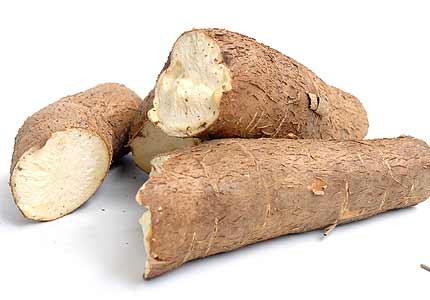
Cassava Corn

Posted by: "ReinhildG" in Yahoo's PanamaForum:


Brown, hairy and ill formed is an apt description of the ubiquitous cassava corn. You can learn more about this foundation food that supports almost one third of the world's population at the Three Sisters next Saturday the twelfth of June in El Valle.

For more info contact:

reinhild.gamboa@gmail.com

Cassava is very common in Panamanian grocery stores and farmer's markets. Here's a recipe by Panama's "Cooking Diva" for cassava chocolate cake with coconut milk and vanilla ice cream. If that doesn't get you interested in cassava, I don't know what will.

Cassava, from the Taino (Arawak) casavi meaning flour, has 5000 wild and cultigenic varieties world-wide, each adapted to a different environment and ecological niche, comprising 30% of the annual reported global tuber harvest.

This perennial root crop is the most prolific calorie producer on the globe and harvesting cassava is highly labor intensive providing jobs for its many small-scale producers. Its breadth of applications and high perishability allows farmers to participate in the marketing chain by rudimentary processing methods.

There are two major classifications: bitter and the sweet, although in truth the bitter is not bitter and the sweet is not sweet, with the distinction relating more to size and toxicity then any palate values.

Low herb like or branched shrubs are usually of the sweet, smaller cormed, less toxic variety while the slender unbranched tree type, usually producing a single corm, represents the bitter. The bitter variety is a higher elevation drier cultivar while the sweet version prefers the lowlands and more irrigation.

Cassava and cheese empanadas from Peru:


Never eat cassava raw! Both varieties contain sharp oxalic acid crystals that can damage the stomach lining and hydocyanogenic toxins that can prove fatal if not removed by either processing or cooking. Most processed products are made from the bitter variety while the sweet type is what is sold in local and stateside markets so don't overreact.

Cassava requires three months of wet conditions to establish itself and then takes 6 to 12 months to mature and the bitter variety can remain in the ground for an amazing 4 years before harvesting!

Bitter cassava usually has a larger, often singular, tuber with 50 times more toxin then the smaller multiple corms of the sweet cultivar. The freshly harvested cooked leaves of the sweet variety are eaten as pot greens or challoos and the raw unprocessed corm can be used for livestock fodder.

Wednesday, March 31, 2010

Predicting an Expatriate's Level of Happiness Over Time

Ashok, in his fascinating, informative, and occasionally hilarious blog about life in India, has charted the average level of contentment of freshly arrived expatriates in India. I think his findings are applicable to Panama as well:

"There has been enough expatriate evidence acquired to actually predict and plot an expatriate's happiness or contentment over time.

Because of the excitement of the adventure, you start at a 10. The first month is culture shock. Drop to 7. The second month is honeymoon. Jump to 9. Then real life starts to smother you and you lose your elasticity to novel situations. By the end of the sixth month you are at a 3,but then you begin to understand the situation and what you need to do to succeed. A plateau occurs at the 12th month when you’re at 6.

Three. Today is three..."

Monday, January 11, 2010

El Valle Annual Concert by National Symphony Orchestra on January 30th


Although El Valle is a small town with a largely indigenous population, it also has a significant population of "weekenders" - rich Panamanians who keep vacation homes in the cool climate of El Valle, as a getaway from the heat of Panama City. There are many palatial homes in El Valle, especially along the circumference of the town, at the feet of the foothills. Some of them have vast, manicured grounds with gardens, streams, ponds and horse stables.

Because of this, things happen in El Valle that you would not normally expect in a little mountain town. Among those is the annual pilgrimage of Panama's National Symphony Orchestra to play in El Valle's little church. The streets outside the church fill up with SUV's as well dressed families fill every pew in the church. Less affluent residents who cannot afford the tickets stand outside the door and peer in the windows to benefit from this special event.

I went once with Laura and Salma, and Salma was initially entranced, but as the evening progressed and we were well past her bedtime she became cranky. I tried taking her outside and rocking her in my arms, but she would not settle down and eventually we had to take her home to sleep.

This year's concert is coming up and will be the 19th annual concert. Here is the official flyer for this year's event:

XIX Festival Musical de El Valle
Saturday, the 30th of January, 2010 at 8:00 pm
Iglesia San Jose in El Valle de Antón, Coclé, Rep. de Panamá
***
La Asociación del Festival Musical de El Valle
y el Instituto Nacional de Cultura (INAC)

Presents
GRAND CONCERT
NATIONAL SYMPHONY ORCHESTRA
Director, Maestro Jorge Ledezma

Guest Soloist: JINGJING WANG
(CHINA)
First Prize winner of Panama's 2008 International Piano Competition

PROGRAM

1. Astor Piazzola The Death of the Angel
(for string orchestra , soloist Juan Castillo)

2. Georges Bizet Suite from "Carmen"

Intermission

3. Robert Schumann Piano Concerto in A Minor, Op. 54
Guest Soloist: JingJing Wang
(Piano)

TICKETS are available for $15.00:
In El Valle: at Centro Comercial de El Valle or at the entrance of the Church the night of the performance
In Panama City: at Ingeniería R-M or at Joyería Barakat
Email: festivaldelvalle@gmail.com

Tuesday, December 22, 2009

"Are You Healthy? Are You Crazy?" Getting a Panamanian Driver's License if You're Over 70


Jan Knight writes on the Panama Forum that her husband, who is 78 years old, recently applied for a Panamanian driver's license. Apparently anyone over the age of 70 must have a letter from a doctor stating that he is healthy and mentally stable (i.e. not senile).

They went to a doctor who looked at Jan's husband and said, "Are you healthy?"

"Yes."

"Are you crazy?"

"No."

The doctor looked at Jan for confirmation of these facts, then wrote the letter out by hand.

Thursday, November 19, 2009

Things that take you back: ordering a Subway sandwich


After a gym workout this evening, I went looking for something to eat and noticed a Subway sandwich shop at Shaw and Palm, across from the Fig Garden Village center. I pulled up just a few minutes before closing and was not surprised to see a young Indian woman behind the counter. So far, every Subway I've visited in Fresno has been owned by Indians. Gotta love that enterprising spirit. Can you imagine going to India and monopolizing the samosa industry?

In Panama I went to Subway more often than I ever did in the USA. When I lived in El Dorado I frequented the one on the "Do-It Center" street, in the small shopping center that has the two Chinese vegetarian restaurants. After I moved to El Valle de Anton, I used to stop at the Subway in Coronado whenever I was on my way back from the city. The first several times I had to ask the names of the various sandwich ingredients, and the staff always answered me with a chuckle or a smirk. In time, as my Spanish improved and I racked up the Subway visits, I became very comfortable ordering in Spanish.

Walking into the Subway tonight, I had a flashback to Panama, and had to resist the urge to order "atun grande con pan integral."

Somehow life in Panama was richer, more full of the "stuff of life" in a way. More friendships, more interesting experiences, more challenges, more frustration and laughter and spirit-lifting beauty.

I was talking to a friend recently, and I said that I didn't know how to think of Panama now. What is it to me? What does it represent? And my friend said, "I think it is your home."

Tuesday, September 8, 2009

How to eliminate silverfish

No, not this kind of silverfish:


This kind!


This creepy little insect is a silverfish. I hate these disgusting little creatures. They don't bite and don't carry diseases, but they move in a fast slither that is just plain creepy; and if you're fast enough to smack one, they smear into a grey smudge.

In Panama (especially in rural areas), silverfish will be found in any place that has books, paper, cardboard, boxes, etc. I never saw them in Panama City, but I saw plenty in El Valle de Anton. This may be because of El Valle's elevation and relative coolness. Silverfish don't like temperatures above 80 Fahrenheit.

Silverfish especially eat foods and products that are high in protein, sugar, or starch. This includes vegetable foods, such as flour and cereal; fabrics, including cotton, linen, silk, and rayon; sizing in paper; starch in clothing; and paste or glue. They also eat wallpaper, book bindings, and paper when trying to feed on the glue or paste underneath them. Their damage is usually recognized from their irregular feeding marks and the presence of feces. Silverfish and firebrats can go for months without feeding.

They lay eggs in cracks, crevices, and other narrow, confined spaces. Silverfish prefer cool, moist, dark places with temperatures between 70o - 80° F and a relative humidity between 75% - 95%. They are often associated with basements, closets, bookcases, and storage areas.

How to Get Rid of Silverfish

Silverfish and firebrats are associated with damp conditions. You can reduce their numbers by correcting moisture problems:

  1. Dry out damp areas with a fan or dehumidifier.
  2. Repair leaky pipes.
  3. Ventilate closed rooms.
  4. Repair leaking roofs.
  5. Seal concrete walls and floors.
  6. If the problem occurs in a bathroom, make sure the ventilation fan is used during baths and showers.
  7. If you can not move materials, provide air spaces between boxes and other objects to promote air circulation.
  8. Keep in mind that as air cools the humidity in that air increases, so using a dehumidifier or gently heating the surrounding air can have a big impact on the infestation!

You can also reduce silverfish and firebrats by removing sources of food, especially in damp areas. You can reduce potential hiding places by removing old papers, books, boxes and other clutter. Seal cracks and crevices, including those found in baseboards, cupboards, and walls to limit harborages.

Kill Silverfish with Boric Acid

Last but not least, poison them! This can be done with boric acid, a type of inorganic dust. Common trade names include Roach Powder® and Roach Prufe®. Diatomaceous earth, also known as silicon dioxide, is also available. A representative trade name is Concern®. Follow the label and place the dust in cracks and crevices where silverfish have been sighted. Do not apply dust where children and pets can reach it.

You can also make residual spot treatments along baseboards, cracks and crevices, and other areas where silverfish or firebrats are found. Insecticides, such as permethrin, deltamethrin, cyfluthrin, and cypermethrin are effective insecticides against these insects.

In Panama you can purchase boric acid (acida borica in Spanish) at most hardware stores or Chinos (Chinese-owned corner stores). Buy it in bulk, by the pound if possible, rather than the small packets sold in the Chinos.

Borax Soap for Ants

Doug on Panama Forum points out that you can also use a 50-50 mixture of borax soap and icing sugar to get rid of sugar ants. The ants take this toxic mixture to their nest and share with the colony, and they all die.

On that cheery note, take care and be silverfish-free!

Monday, September 7, 2009

Find a way further in

Stained and White Ivory Muslim Style Chess Set Cambodia 18th to 20th century

I'm watching a movie called The International. A high-ranking executive of a powerful but corrupt bank is teaching his son to play chess. His colleagues call him on a conference call to discuss a messy situation that is threatening the entire bank.

The executive turns to his son and asks, "What do you when you are stuck in a situation from which there is no way out?"

He's asking in terms of chess theory. His son understands this. His son replies, "If there's no way out... you find a way further in."

Whoa. He's exactly right. This is what the chess grandmasters do. They marshal their resources and launch an attack, and press it. They know that once they commit, it's do or die. They sacrifice and drop pieces to the left and right like shattered swords. And if they are clever, creative and persistent enough, they break through and topple the enemy's king. They play in a way that seems brilliant and reckless, but is actually brilliant, calculated and single minded. Bobby Fisher was famous for this.

I've often felt that chess is a metaphor for life. Imagine living your life that way. That would take much courage. But if you look at anyone who has truly made it big in life, you will see the same pattern, the same go-for-broke mentality.

I remember developing the website that is now my primary earner. It was back in 1998 or so. I hired a company in India to build what I needed for $5,000. I had no money and didn't know how I would pay them. Somehow I came up with enough money each month to pay installments until the website was complete.

Now I would not sell that website for less than $300,000.

Do you have a story of committing yourself fully to something, with no backing out? How did it turn out?

P.S. The photo depicts an antique Islamic chess set from Cambodia.

Tuesday, September 1, 2009

Arroz Con Leche (rice with milk) for a baby's first tooth

The little daughter of my lawyer and friend Berliza recently cut her first tooth. The baby's name is Maria Fernanda, or Marifè for short.

I mentioned to Berliza that some cultures celebrate this event, and she told me that indeed in Panama there is a custom for this:

"In our culture the tradition is that the first person who sees the tooth has to cook rice and milk (a dessert). We put them in little containers, usually nicely decorated for the occasion and we give them away to friends and family. We are working on that right now."

This rice and milk dessert is called in Spanish arroz con leche. In the photo you see the actual dessert that Berliza made.

And here is lovely little Marifè getting her first taste:

Tuesday, August 25, 2009

Should We Try to Change Panama?

There are always discussions on the Panama Forum between those who feel that new immigrants and residents of Panama have a right to try to effect change; and those who feel that we are guests in the country and should not be so presumptuous as to try to change their culture.

Ronald Davis recently wrote an interest post on this subject, and I'm reprinting it here. Comments are welcome:

***

"Those who come from far away lands to these Panamanian shores to seek refuge and a new beginning - and who often times spend a whole lot of their money, time, and effort in this new land, and who subsequently see an "evil" in their newly adopted land - once the rosy colored glasses have been removed - are, in my opinion, honor bound to try and achieve change so that such an "evil" does not continue to occur in the future. Whether you succeed or fail in youir endeavor is of secondary consequence.

However, those ex-pats who sit back and do nothing about said "evil", who merely observe the passing landscape as if said landscape were in a book of fiction they were reading should be, in a more just world, consigned to some inner circle of hell.

Complications and Nuances: Clearly there is such a thing as cultural relativity, even situational ethics. And this is something that must, by all means, be taken into account. To wit: What is good or culturally acceptable in Country A is not always considered good or culturally acceptable in Country B. Some examples of this would be female genital mutilation, consigning newly widowed woman to funeral pyres, eating primates or dogs, beating wives and children, keeping slaves [yes, slavery still exists in parts of this world] and so on and on. Of course, there are many other examples of these cultural differences, some important, some not so important - and thus my use of quotes around the word evil.

Sooo . . . if you are living in such a new land and you were to see something that gives you great distress, something that you see as truly wrong, what should you do about it? Just sit back, look the other way, and accept these practices - whatever they may be - as indigenous to a given culture and, therefore, not worthy of public comment or even public action on your part? That's certainly one way to look at it. But if you were to decide to travel down this path, would you not also be complicit - in part or in whole - in what is - by your own definition - an evil? And would it not be condescending, really condescending, if you were to say that a given culture, a given people, has been doing same for a thousand years and, after all, they cannot/will not change, and, so, who are you, one person, to try and change them?

Puh-leaze!

All cultures, all peoples change, evolve, and metamorphize into something new and different over the years. Some from internal, some from external forces. Some quickly, some slowly.

So the only question for me is how to achieve change when you decide change is really neccesary and to what degree can an individual do so? Trying to ram something new down someone's throat rarely, if ever, works. So the method of going about how to change someone/something need - common-sense should always dictate - be one of evolution, not revolution; one that is carried out with great care and greater tact. And it often needs be shown that there are specific benefits - usually economic - to adopting a new way, a new method, if you are to be successful in your endeavors.

On a tiny, even infinitesimal level, as an example, it is showing visible displeasure when a Panamanian worker shows up three hours late for a job you have hired him/her for. But how to express your obvious displeasure is the key to this kind of situation. Humor, anger, sarcasm, even economic sanctions [i.e., firing the bobo/boba on the spot and telling him/her you will only deal with workers in the future who can tell time, and, in addition, that you find it personally insulting that he/she cares so little about you that he or she can needlessly waste your time like he/she already has], all these methods and others have their place in your possible responses to this kind of situation.

But to just sit back and say nothing, except on this forum, or to stew in your own angry juices and do nothing about this kind of a situation, is to my way of thinking, totally unacceptable. To say that the "manana" concept has been and, therefore, will always be a part of Latin culture is also unacceptable and, again, such an approach, I believe, is to treat people in a condescending manner, much like you might treat a retarded child whom you believe is incapable of growth or change. Tell me that kind of attitude here in Panama does not often border on racism?

England like Panama has been a racist society for many years. There were times in Great Britain when an English worker refused at his place of employment to even sit next to a "Packy" and now, years later, the most popular of all foods sold in Great Britain comes from the Indian subcontinent and who you work besides has as much relevance as where your shoes are made or the color of your socks.

The U.S. like Panama has been a racist society for many years. There were times in the U.S. when having a black president was as conceivable as flying to the moon and then . . . ahem . . . things changed.

My wife and I have had many excellent Panamanian workers in our employ since our arrival here four years ago - and some true slackers too. Many of the best of them were trained in the Canal Zone and are proud of their acquired skills and the importance of being on time. There are also companies here in Panama who have spent considerable time, effort, and money in training their workers to be more efficient and proud of their work. If they can do it, so can you, albeit, on a more personal level, IF the desire, patience, and good will is there. Small changes over time can become big changes.

Else, in my opinion, go quietly into the night and dare not criticize your newly adopted country for any reason, for you have no right to do so - at least not within my hearing."

- Ron

Sunday, August 23, 2009

Essential Ramadan Reading

Some phrase or image on my blog related to Ramadan seems to be sending some serious search engine traffic my way - as in 800 readers in a single day! - so I thought I would give you folks something productive to do with your time, ha ha.

Here are some excellent books that I consider essential Islamic reading. Any one of them would be great to read a little from every evening after Iftar, or to give as a gift. All are available through the link below:


1. An Interpretation of the Qur'an : English Translation of the Meanings : A Bilingual Edition (Majid Fakhry) - I have this and I read it often. It's an excellent, modern and scholarly translation. If you're still reading Yusuf Ali's poetic but archaic translation, it's time to check out something different.

2. The Qur'an : A New Translation (Dr. Thomas Cleary) - I would have listed this first except that it's in English only. The language is modern and clear, yet retains some of the powerful poetry of the Arabic. I highly recommend it.

3. Muhammad : His Life Based on the Earliest Sources : Revised Edition : Martin Lings (Abu Bakr Siraj Ad-Din) - All-time best-selling book on the life of the Prophet (pbuh), now the latest revised edition. You may have read some of the briefer Seerahs (biographies of the Prophet Muhammad) such as The Sealed Nectar of The Life of the Prophet Muhammad, but you have not experienced the breadth and depth of Muhammad's (pbuh) struggle and indomitable character until you have read this book.

Well, as you can see my preference is for more scholarly works, but you can find all kinds of good stuff at IslamicBookstore.com, including children's books, movies and CDs, and toys. I have been shopping with them for several years now.

Wednesday, August 19, 2009

Happy Ramadan and may every year find you well

The holy month of Ramadan is almost here and I'd like to wish a Ramadan Mubarak - blessed Ramadan - to all my Muslim readers.

Ramadan is such a special, unique time. On the one hand the fast of Ramadan is the most personal and challenging act of worship that a person can dedicate to God, aside perhaps from the Hajj. On the other hand, it is a time of family and community. It builds and strengthens so many of the best aspects of human character: patience, compassion, perseverance, and taqwa (God-consciousness).

We fast not only from food and water, but from anger, impatience, corruption, selfishness, and causing hurt to others. We renew our spirits so that we come out of Ramadan with a new feeling of dedication to God, pledged to do better, and strong to face the challenges of life.

I always have mixed feelings about the coming of Ramadan. After all, it is quite difficult, especially during these summer months when the days are long and hot (not so much for those of you in Panama, lol, where the days are always the same length and the seasons are only rainy or dry - but here in Central California summer days are in the 100 to 110 degrees range).

On the other hand, it's such an exciting time, offering the prospect of spiritual purification and forgiveness from God. And that overcomes any trepidation that I may have.

At the same time, I have a major web project going on - a complete overhaul of the Zawaj.com Muslim matrimonial service. I'm excited about that.

Take care. My best wishes to all of you, regardless of your faith. Keep your heads up, know God, and know yourselves. If any of my Panama friends are reading this: Henry and Nora, Rudy and Christina, Cleo and family, Niko and family, Zach and Danyelle, Berliza and family, Dr. Medrano, Bill and Adam Brunner, Rosa and family, Listo, Ani, Corrin, Rene, and all the rest (forgive me if I did not name you!), you are all dear to my heart and I am thinking of you.

To my non-Panama friends, well, there are too many to list, so: Ramadan Mubarak, and peace be upon you.

I've been browsing the web, reading articles about Ramadan and looking at photos, and I have come across some of the most amazing and beautiful Ramadan photos. Here are the links for your pleasure. The first batch comes from Boston.com, published last year.


Next are some outstanding photos from Time Magazine:


And a couple of beautiful images from National Geographic (one photo per URL):